
 Back
Test Automation with AI and Playwright: 40–70% Time Savings
While redesigning an application for a major French government ministry, QESTIT’s QA consultants automated test cases using Playwright, TypeScript, and AI agents. Estimated time savings: 40% to 70% depending on the phase of the test cycle - equating to approximately two automated test cases per day, compared to two days per case previously. The key: not every agent, but the right ones, built on a solid architecture, and managed by an experienced automation engineer.0
Two days to automate a single test case. That was the pace a major French government ministry was facing while overhauling one of its applications. With hundreds of manual tests to rerun with every update, the cost was set to be steep.
The QESTIT team approached the problem differently: what if AI did the bulk of the work, under the supervision of an expert?
The context: a redesign, with tests that had to be rerun endlessly
Every update to the application required retesting the same workflows manually, over and over again. QESTIT assembled a full QA team: a Test Manager, two manual testers, and an automation consultant, Wadi.
The client had two priorities: staying within budget and moving faster. Automating repetitive tests addresses both, provided it doesn’t take months to do so.
Which tool should you choose to automate your tests with AI?
After discussions with the client, the decision was made to use Playwright with TypeScript, two open-source tools, meaning no licensing costs. The deciding factor: Playwright offers AI agents capable of reading the application and the code. Selenium does not.
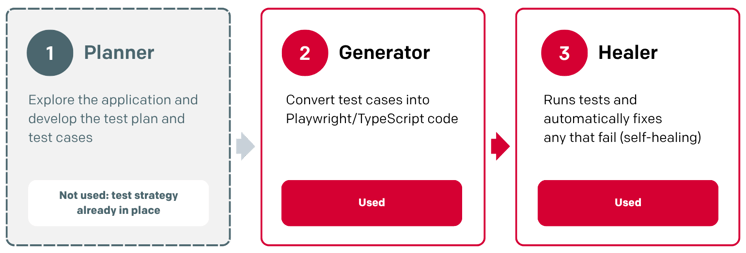
Playwright provides three agents:
- The planner: it explores the application and generates test cases and the test plan;
- The generator: it converts test cases into automated code;
- The healer: it runs the tests and automatically fixes any that fail (self-healing).
Do we need to use all of Playwright’s AI agents?
No, and that’s where the consultants’ experience makes all the difference. The project already had a testing strategy led by the Test Manager, along with written test cases. The Planner would not have added any value.
The team kept two out of three agents: the Generator to write the code and the Healer to maintain the tests. Fewer tools, greater efficiency. Knowing what not to use is also a sign of expertise.
What are the prerequisites for successful automation with AI?
AI isn’t a magic button. Two conditions make all the difference.
-
An architecture in place before AI. The consultant first builds the testing framework. Only then is the AI connected to it to read the existing code and learn the project’s conventions. The agents only get to work after that.
-
An experienced automation engineer at the helm. The AI makes suggestions; the expert makes the decisions. You need to be proficient in Playwright to challenge the generated code and verify that it actually works. A junior consultant would accept anything. This is the real key to success, and that’s why Qestit assigns senior consultants to this type of project.
What are the concrete time savings with AI and Playwright?
The team estimated the time savings provided by the agents at each phase of the automated test development cycle:
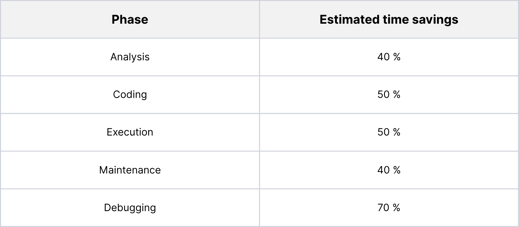
The time savings amount to at least 40% across all phases, and up to 70% during debugging—where self-healing makes the biggest difference. In the most favorable test cases, this translates to approximately 2 automated test cases per day, compared to 2 days per case previously.
Result: The client automates faster, spends less, and its testers can focus on what truly requires human intervention.
Tips from our consultants to get started
- Choose a tool based on your AI ecosystem, not just out of habit. An open-source tool with built-in agents significantly speeds up execution.
- Activate only the agents you need. If you already have a testing strategy in place, there’s no need to reinvent it.
- Structure your approach before automating. AI integrated into a clean architecture produces clean code.
- Keep an expert in the loop. They guide, challenge, and validate each result.
Do you have tests that need to be automated? Ask our experts for their experience!.
Want to learn Playwright? Check out our Playwright training course.
Article written in collaboration with Wadi Aizouki, an automation QA consultant and trainer for QESTIT France.